
Dr. Savitha Sam Abraham
Lecturer, Department of Computer Science, City St George’s University of London

Brief Bio
Dr. Savitha Sam Abraham is a Lecturer in the Department of Computer Science at City, St. George’s University of London. She earned her PhD from the Indian Institute of Technology Madras (IITM), India, where her research focused on applying Artificial Intelligence in education—specifically, developing AI-based learning tools that teach students how to solve Physics and Mathematics word problems through illustration.
She was a visiting research scholar at Queen’s University Belfast, where she explored the topic of fairness in machine learning. Her work examined how uncritically relying on algorithmic decisions in high-stakes domains can perpetuate and amplify societal biases, often disadvantaging underprivileged groups. This research led to the development of fair unsupervised machine learning algorithms.
Dr. Abraham further advanced her research in neuro-symbolic AI as a postdoctoral researcher at Örebro University, Sweden, and later at the University of Adelaide, Australia. Her work focused on applications such as multimodal question answering.
Her current research interests include AI for Education, evaluating the soundness of reasoning in AI systems, and enabling AI models to produce symbolic explanations to justify their decisions—key steps toward building more transparent and trustworthy AI agents.
Ambitions for the London ACM-W Chapter
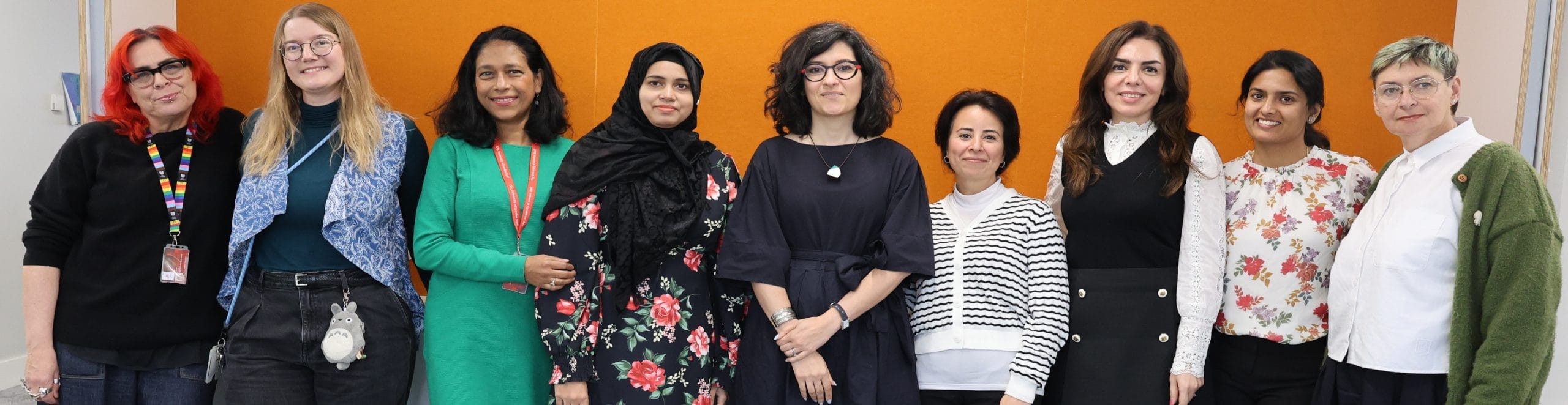
One of the most empowering realisations in any career journey is knowing that you’re not alone—that there is a community of women who share similar goals, ambitions, and challenges. This sense of solidarity is something Dr. Abraham hopes to foster through the London ACM-W chapter. She believes that having a space to share experiences and learn from one another is not just valuable—it’s a privilege.
She also hopes to use this platform to engage with young school students by showcasing the exciting and meaningful work being done by women in science—particularly in areas like AI for education, healthcare, fashion, and entertainment. These outreach events can highlight real-life role models—women who were once girls with the same doubts and insecurities—and can inspire the next generation of girls to envision themselves in STEM fields.